這到底發生了什麼事情?
System.ObjectDisposedException: 無法存取已處置的物件很正常的,微軟的中文版錯誤訊息不只難懂還可能讓人搞錯方向。他對應的英文訊息是:
Cannot access a disposed object.
這邊說的「已處置」就是"disposed",某個物件被處置掉了所以不能夠再被使用。
可能解法:
if (form1?.IsDisposed == true)
{
    form1 = new Form1();
}
這到底發生了什麼事情?
System.ObjectDisposedException: 無法存取已處置的物件很正常的,微軟的中文版錯誤訊息不只難懂還可能讓人搞錯方向。他對應的英文訊息是:
Cannot access a disposed object.
這邊說的「已處置」就是"disposed",某個物件被處置掉了所以不能夠再被使用。
可能解法:
if (form1?.IsDisposed == true)
{
form1 = new Form1(); }
Open the project's Properties page.
Click the Build property page.
Select the Allow Unsafe Code check box.

the following is a method declared with the unsafe modifier:
unsafe static void FastCopy(byte[] src, byte[] dst, int count)
{
    // Unsafe context: can use pointers here.
}
The scope of the unsafe context extends from the parameter list to the end of the method, so pointers can also be used in the parameter list:
unsafe static void FastCopy ( byte* ps, byte* pd, int count ) {...}
You can also use an unsafe block to enable the use of an unsafe code inside this block. For example:
unsafe
{
    // Unsafe context: can use pointers here.
}
To compile unsafe code, you must specify the -unsafe compiler option. Unsafe code is not verifiable by the common language runtime.
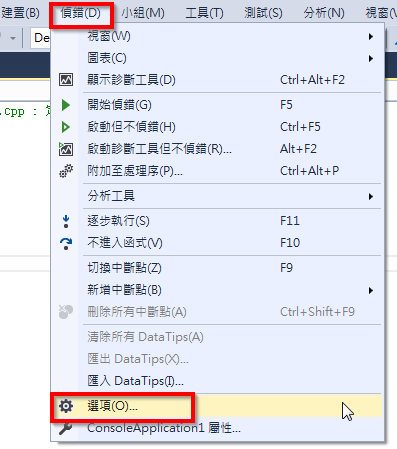
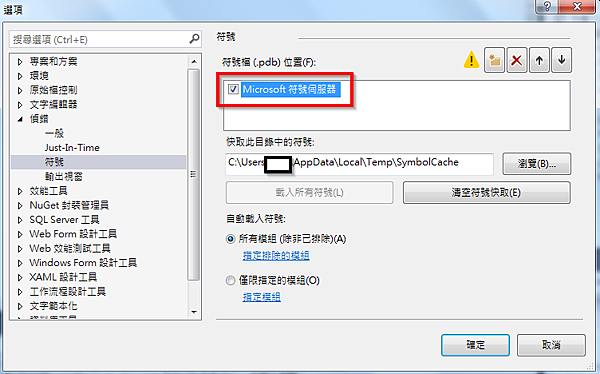
解決"找不到或無法開啟 PDB 檔案"在Visual C++ 2015 Community (VC 2015)
上網找了一下都是舊文章
新的選項的位置不同。
解決方法
偵錯-->選項
偵錯-->符號-->把Microsoft符號伺服器打勾)
Attribute classes can have positional parameters and named parameters. Each public instance constructor for an attribute class defines a valid sequence of positional parameters for that attribute class. Each non-static public read-write field and property for an attribute class defines a named parameter for the attribute class.
The example
using System;

[AttributeUsage(AttributeTargets.Class)]
public class HelpAttribute: Attribute
{
    public HelpAttribute(string url) {        // Positional parameter
        ...
    }

    public string Topic {                     // Named parameter
        get {...}
        set {...}
    }

    public string Url {
        get {...}
    }
}
defines an attribute class named HelpAttribute that has one positional parameter, url, and one named parameter, Topic. Although it is non-static and public, the property Url does not define a named parameter, since it is not read-write.
This attribute class might be used as follows:
[Help("http://www.mycompany.com/.../Class1.htm")]
class Class1
{
    ...
}

[Help("http://www.mycompany.com/.../Misc.htm", Topic = "Class2")]
class Class2
{
    ...
}using System;
[AttributeUsage(AttributeTargets.Class | AttributeTargets.Interface)]
public class SimpleAttribute: Attribute
{
...
}
defines an attribute class named SimpleAttribute that can be placed on class_declarations and interface_declarations only. The example
[Simple] class Class1 {...}

[Simple] interface Interface1 {...}
shows several uses of the Simple attribute. Although this attribute is defined with the name SimpleAttribute, when this attribute is used, the Attribute suffix may be omitted, resulting in the short name Simple. Thus, the example above is semantically equivalent to the following:
[SimpleAttribute] class Class1 {...}

[SimpleAttribute] interface Interface1 {...}Ref: https://codertw.com/%E7%A8%8B%E5%BC%8F%E8%AA%9E%E8%A8%80/42191/
SDM :Snapdragon Mobile
MSM :Mobile Station Modems
APQ :Application Processor Qualcomm
MPQ :Media Processor Qualcomm
QSD :Qualcomm Snapdragon
TPP :Test Plan Package
MFG : 大概是 Manufacturing
CS :Commercial Software
DSDA :Dual Sim Dual Active
DUT :Device under test
EVP :Enhanced Power Verification
FC :Feature Complete
FFBM :Fast Factory Bootmode
FTM :Factory Test Mode
FTMRFT :FTM RF Test is a new FTM command set introduced on the Atlas modem. It replaces the FTM RF commandset used on other modems.
MM :Multimode
NSVFS :Non SignalingVerification Frequency Sweep
QSEQ :Qualcomm Test Sequencing Systems
RFVFS :RadioFrequency Verification Frequency Sweep
VFS :Verification frequency sweep
QMSL : QUALCOMM Manufacturing Support Library
QRCT : QUALCOMM Radio Control Tool
QPST : QUALCOMM Product Support Tool
QSPR : QUALCOMM Sequence Profiling Resource
XTT :QSPR subsystem test libraries and extensible test tree files


